The First 250 Founders Decks Are Coming Soon -- Don't Miss Your Spot!
Evidence-Based
INSIDE THE FORGE
3 min read
Focusing on High-Impact Skills First
One of the most important design decisions in Phonic Forge is what it includes—and what it doesn’t.
Research in instructional psychology and language development shows that not all reading skills carry the same weight. Some sounds, spelling patterns, and words appear constantly in English, while others are rare. Teaching everything at once can overload memory and slow progress.
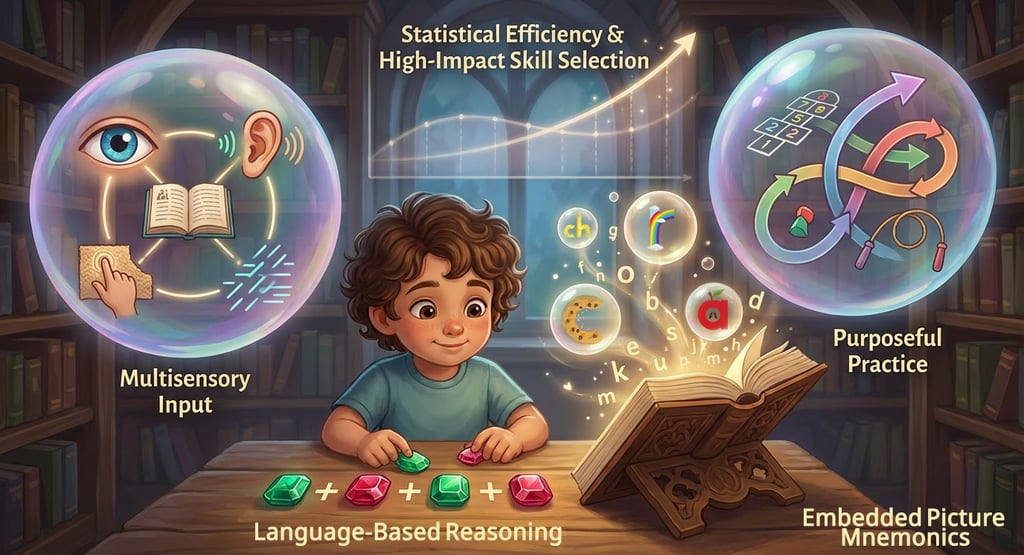
Instead, Phonic Forge focuses on high-impact letter–sound patterns—the ones children will see and use most often. This approach is supported by statistical patterns in language (often described through ideas like the Pareto Principle and Zipf’s Law), which show that a relatively small set of skills unlocks a large portion of written English.
By prioritizing these patterns, children gain access to real reading more quickly—without being overwhelmed.
Embedded Picture Mnemonics: Seeing the Sound
Another core feature of Phonic Forge is the use of embedded picture mnemonics, where images are built directly into letter shapes to represent sounds.
This design choice is grounded in research on dual coding, which shows that learning is stronger when information is stored both visually and verbally. When children can see a sound and say it at the same time, recall becomes easier and more reliable.
Instead of memorizing abstract symbols, children connect sounds to familiar images—supporting memory while reducing mental effort.
Multisensory Learning, Built In
Phonic Forge is intentionally multisensory. Children:
see sounds through visuals and patterns
hear sounds through speech and play
move, touch, and interact through cards and games
Research consistently shows that multisensory learning supports stronger engagement and retention. While not every child needs multisensory input, all children benefit from it—especially when learning something as complex as reading.
In Phonic Forge, multisensory learning isn’t an add-on. It’s built directly into how the game is played.
Learning Through Play and Games
Practice is essential for learning—but how children practice matters.
Phonic Forge uses gamified learning to turn repetition into something purposeful. Instead of drills or worksheets, children practice skills by following rules, taking turns, making predictions, and solving problems within a game.
Research shows that learning embedded in play:
increases motivation
supports attention and self-regulation
encourages language use
and helps skills stick
Because the practice has meaning, children stay engaged longer—and learning becomes something they want to do.
Designed for Efficiency and Growth
Another evidence-based principle behind Phonic Forge is efficiency. Learning works best when new information builds on what children already know.
The game is designed to:
reduce unnecessary memory load
layer skills gradually
and grow in complexity as children develop
Younger children can engage with the visuals, matching, and play routines. As children grow, those same games support more advanced phonics, word building, decoding, and spelling—without needing to relearn the structure of the activity.
Why All This Matters
Phonic Forge wasn’t created by following a single program or philosophy. It was built by intentionally combining multiple research-backed strategies to support how children actually learn.
It was also designed by a speech-language pathologist working within real-world limits—short sessions, diverse needs, and very little time. When you have thirty minutes a couple of times a week, you can’t afford tools that target only one skill at a time. You need learning to do more.
Phonic Forge was built to support many interconnected skills at once: language, vocabulary, phonological awareness, early literacy, articulation, question answering, social interaction, and self-regulation. Not because these skills are interchangeable—but because they naturally develop together, and research consistently shows they are strongest when taught in meaningful, connected contexts.
Rather than isolating skills into separate drills, Phonic Forge brings them together through purposeful play. The game structure creates realistic opportunities for children to use language, think, problem-solve, follow rules, and practice sound–symbol relationships all at the same time.
This approach reflects both research and practice: combining high-impact strategies into activities that are efficient, engaging, and usable in real learning environments—whether that’s therapy, classrooms, or home.
That’s what Evidence-Based by Design truly means.
Questions? We're happy to help.
info@graphonicmnemonics.com
© Graphonic Mnemonics LLC | Privacy Policy | Terms & Conditions