The First 250 Founders Decks Are Coming Soon -- Don't Miss Your Spot!
Fits Any Curriculum & Grows With Your Child
INSIDE THE FORGE
3 min read

Why Phonic Forge Is Designed for Ages Three and Up
Although Phonic Forge explicitly supports the phonics and word skills taught from kindergarten through second grade, it’s intentionally designed to be used earlier—because reading doesn’t start with reading.
Long before children are ready to connect letters to sounds, they are building the skills that make later learning possible. These include:
attention and focus
vocabulary growth
turn-taking and social interaction
communication and expressive language
emotional regulation and flexibility
reasoning, predicting, and problem-solving
Phonic Forge uses familiar game structures and picture-based graphics to support these foundational skills through play, starting as early as age three.
Developmentally Appropriate From Kindergarten Through Second Grade
Phonic Forge supports the phonics and word-level skills children typically develop between kindergarten and second grade.
As children play, they work with:
letter sounds
early word patterns
building and breaking apart words
expanding phonics patterns as skills grow
The games are designed to grow with your child. As skills develop, the level of challenge can increase, allowing the same materials to remain useful over time rather than being outgrown quickly.
Learning Through Play Comes First
At ages three and four, children don’t need phonics instruction—but they do benefit from structured play.
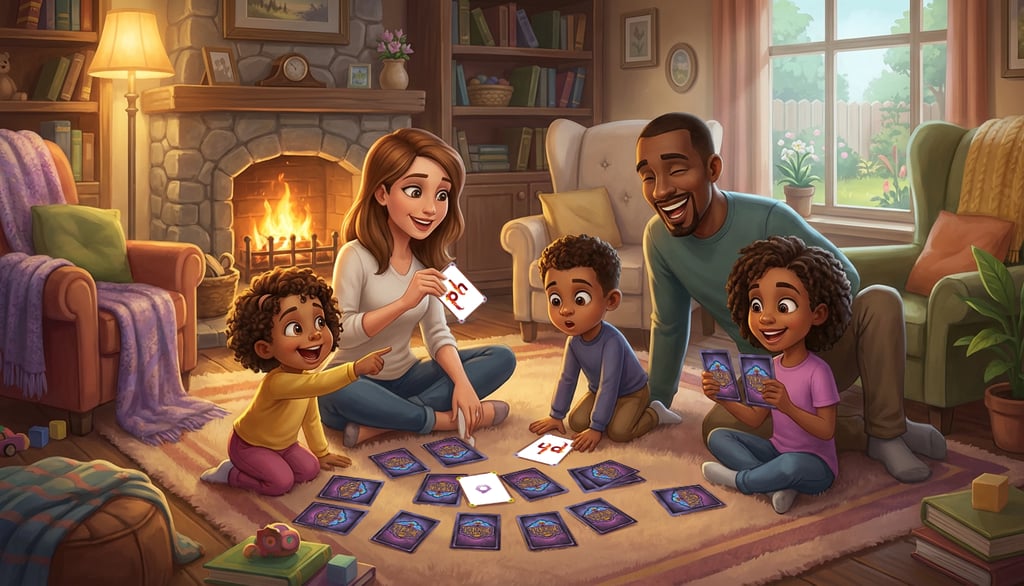
Matching games, picture-based activities, and simple turn-taking games allow young children to:
practice visual attention and matching
talk about what they see
learn how games work
follow rules
take turns and wait
ask and answer simple questions
At this stage, the focus isn’t on “getting the right answer.” It’s on learning how to participate, communicate, and stay engaged within a routine.
These game routines create a meaningful context for language and interaction—without pressure.
Familiar Games, Deeper Learning Over Time
As children grow, those same games become richer.
By ages four and five, children are more capable of:
explaining their thinking
answering and asking questions
making predictions
handling more complex rules
using language socially and strategically
Because the game structures are already familiar, children can focus their energy on new layers of learning rather than learning a new format each time.
This is where Phonic Forge’s design really shines.
Adding Phonics When Children Are Ready
When children reach kindergarten and beyond, the phonics layer naturally gets added in.
Because the games already:
have structure
have rules
involve language
feel familiar and safe
children are ready to focus on more abstract skills like:
connecting letters to sounds
building and breaking apart words
recognizing sound patterns
decoding and encoding
Instead of introducing phonics in isolation, Phonic Forge embeds it into a learning structure children already know how to use.
The learning doesn’t feel new or intimidating—it feels like a natural extension of play.
Aligned With School Instruction — Without Replacing It
From kindergarten through second grade, Phonic Forge aligns with the same phonics and word-building skills taught in school, grounded in the Science of Reading and structured literacy approaches.
It supports:
single-letter sounds
early word patterns
digraphs, vowel teams, and controlled vowels
Because it focuses on sound–symbol relationships and patterns, Phonic Forge fits seamlessly with any reading curriculum. It doesn’t change what schools teach or the order in which skills are introduced—it simply gives children more meaningful practice within a familiar, engaging structure.
What This Means for Families
Phonic Forge is not just a reading game. It’s a learning routine that grows with your child.
You can start playing at age three to build language, attention, and social skills. As your child develops, the same games support more complex thinking. When phonics instruction becomes appropriate, it’s layered into a structure your child already understands.
For families, this means:
one set of materials
usable across multiple ages
aligned with school learning
easy to use at home
grounded in play, not pressure
A Simple Way to Support Learning at Home
If you’re looking for something meaningful you can do with your child—whether they’re three or seven—Phonic Forge offers a clear answer: play together.
The games grow with your child, fit any curriculum, and support learning through connection, routine, and confidence—long before, during, and beyond formal reading instruction.
Questions? We're happy to help.
info@graphonicmnemonics.com
© Graphonic Mnemonics LLC | Privacy Policy | Terms & Conditions